Trust & Safety
Where Classroom Innovation Meets Security
Lumi is built with security, safety, and privacy at its core. Our platform prioritizes student safety through secure system design, responsible AI use, and clear operational guardrails, so schools can adopt new learning tools without increasing risk.

Where the guide stops
Here is exactly where the guide stops.
Most AI tools describe their safety in adjectives. These are the actual boundaries the guide works inside, and what happens when a student tests them.
✓The guide will
Ask questions about what the student wrote
Point to a sentence and say what is working
Suggest a strategy, like reading it out loud
Explain a grammar rule, using an example from outside the draft
Flag anything unsafe to the teacher, immediately
✕The guide will not
Write, finish, or rewrite a student’s sentence
Generate a paragraph the student could paste
Give a grade or a score to the student
Every exchange is visible to the teacher in real time. Boundaries are enforced in the product, not left to the model’s judgment.
✓The guide will
- Ask questions about what the student wrote
- Point to a sentence and say what is working
- Suggest a strategy, like reading it out loud
- Explain a grammar rule, using an example from outside the draft
- Flag anything unsafe to the teacher, immediately
✕The guide will not
- Write, finish, or rewrite a student’s sentence
- Generate a paragraph the student could paste
- Give a grade or a score to the student
A real kind of request
What happened here: the guide declined the request, kept the student in the driver’s seat, and turned the refusal into the first sentence of the essay. The teacher saw the whole exchange.

Student Data
Belongs to the Student
Students own their data and creations. Lumi collects only what is necessary to deliver instruction and learning outcomes. Student personally identifiable information is never shared, sold, or trained on. Lumi's system is designed with data minimization, purpose limitation, and clear ownership aligned with district and family expectations.

Students own their data

Student data is not shared or sold

Designed with districts & parents

Student PII is not trained on
Meeting, and Exceeding, District Standards
FERPA compliant
COPPA compliant
State student privacy laws compliant (all 50 states)
WCAG / Section 508 accessible
Hosted and residing in the United States
Industry grade encryption
"Lumi is deeply committed to protecting the privacy of students and educators. All educational interactions on the platform are treated as confidential and safeguarded with strict privacy and security practices. Privacy protection is a core part of how Lumi is designed and operated."
— Lumi Privacy Commitment
Designed with Teachers, Literacy Experts & National Advisors
Lumi is guided by national leaders in literacy, equity, innovation, and education policy. Our advisors bring deep expertise across research, AI ethics, K–12 leadership, and learning sciences, keeping Lumi grounded, future-focused, and built for real classroom impact.

Susan Neuman
Susan Neuman is a nationally recognized scholar in early childhood literacy and former U.S. Assistant Secretary for Elementary and Secondary Education. Her research focuses on improving literacy outcomes for underserved communities and shaping eviden

Jean-Claude Brizard
Jean-Claude Brizard leads Digital Promise, a national nonprofit advancing innovation and equity in education. A former superintendent and senior education advisor, he focuses on bridging research, technology, and classroom practice to improve student learning at scale.

Kris Gutiérrez
Kris Gutiérrez is an acclaimed researcher in learning sciences whose work explores literacy development, multilingual learners, and culturally responsive pedagogy. Her scholarship helps districts design environments where all students can participate as knowledge creators.

Isabelle Hau
Isabelle Hau guides major interdisciplinary efforts at Stanford to advance learning innovation across policy, research, and technology. Her work emphasizes equitable access to high-quality learning tools and responsible implementation of emerging technologies.
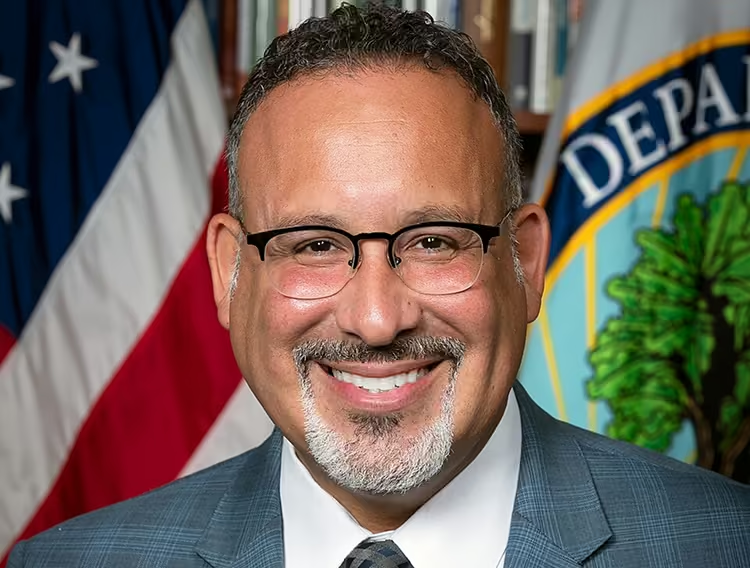
Miguel Cardona
Miguel Cardona served as the 12th U.S. Secretary of Education, championing equity, student support, and modernized learning environments nationwide. His career spans decades in K–12 as a teacher, principal, and state education leader.

Michael Levine
Michael Levine is a leading expert in early childhood development and the impact of digital media on learning. At Sesame Workshop and beyond, he has shaped research-based strategies that support young learners and promote high-quality educational content.
Districts Stay in Control. Teachers Stay in the Loop.
Administrators control
- Data sharing
- Platform permissions
- Student-level, grade-level, or full-district rollout options
- Review + approval of anything published externally
Teachers can
- View student work in real time
- Monitor student interactions
- Provide feedback and guidance
- Intervene anytime
Enterprise-Grade Security
Lumi's infrastructure follows modern security best practices, including strong encryption, access controls, and continuous monitoring. Security is treated as an ongoing process, not a one-time checklist, so protections evolve alongside emerging risks and district needs.

Data
- Data storage and hosting within the United States
- Strong encryption in transit and at rest
Governance
- Documented security & privacy policies
- Continuous third-party penetration testing

Control
- Official roster syncing integrations
- District controlled data sharing
- Single Sign-On (SSO)
Frequently Asked Questions
Lumi uses a layered safety approach designed specifically for K–12 environments. We combine model-level content filtering, Lumi-built guardrails tailored to classroom use, and human-centered review workflows. All AI interactions are structured, logged, and monitored to ensure transparency, accountability, and age-appropriate outcomes.
Yes. Lumi uses structured, age-appropriate AI with teacher visibility into every step.
Only district-approved educators: teachers, principals, and admins. No outside parties ever see student work unless the district intentionally publishes it through Lumi’s publishing tools.
Yes. Lumi is fully FERPA, COPPA, and 50-state student privacy compliant.
No. Student PII is not used to train AI models.
Student data stays under district control. Lumi has official integrations with roster and SSO providers, meaning districts can select and monitor exactly what data is shared, as well as how students access the platform. Lumi retains only the minimum data needed to deliver instruction, stores data in the U.S., and fully encrypts data in transit and at rest. Lumi deletes student data upon district request.